Winter’s Lace

Winter’s Lace

Filigreed fingertips, leftovers from last spring’s new growth
One cannot tell by looking which will survive the winter
With bare branches, death resembles life, life resembles death

Only through winter’s lace
Can one see the honesty of a tree or vine
The nests of life harbored within
Invisible behind the swaying foliage of summer

~~~~~~~~~~~~~~~~~~~~~~~~~~~~~~~~~~~~~~~~~~~~~~~~~~~~~~~~~~~~~~~~~~~~~~~~~~~~

April is Poetry Month. Last year I participated in and completed the challenge to write a poem every day in April. This year my challenge (to myself) is to improve my drawing skills. I may not write a poem a day this month, but I won’t neglect poetry completely. (Remember: You can do anything, but you can’t do everything. ~~ David Allen)
Ephemeral: Weekly Photo Challenge

Texas is in a drought and has been for the last several years. This spring central Texas received some rain and the waterfall at McKinney Falls State Park was flowing. We don’t expect it to last long. Once the heat gets here it will dry up, with hardly enough for a trickle.

Waterfall at McKinney Falls State Park

Spring 2015 rain results

Weekly Photo Challenge: Ephemeral

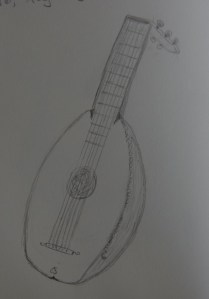
Lute, Sketch 061

Sketch of the Lute

Maybe could make music

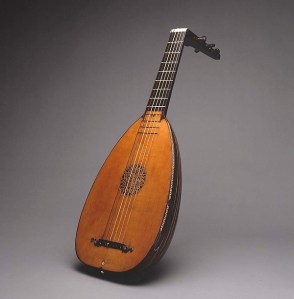
1596; Augsburg, Germany; Wood, various other materials

1596; Augsburg, Germany; Wood, various other materials

Description from the Metropolitan Museum of Art:

The back of this Renaissance lute is constructed of twenty-five ebony or rosewood ribs with ivory spacers, and its top is Alpine spruce. It was probably originally made for seven or eight courses (pairs) of strings, but in the seventeenth century the neck, bridge, and pegbox were replaced or modified to give the instrument a Baroque configuration. In the nineteenth century, the neck was reduced, fixed frets were added, and the instrument was changed to six-strings, like on a guitar.

Sixtus Rauchwolff had an excellent reputation in his day and was a maker of lutes for the prominent Fugger family and the court orchestra in Stuttgart. A label inside the instrument identifies him as the maker and 1596 as the date of the lute. The name of Matthias Hummel, who probably made the Baroque alterations to the instrument, also appears.

Sketch 061: Lute, Metropolitan Museum of Art, Gift of Joseph W. Drexel, 1889