These photographs are contrasts in time.

Winter tree

Summer Tree
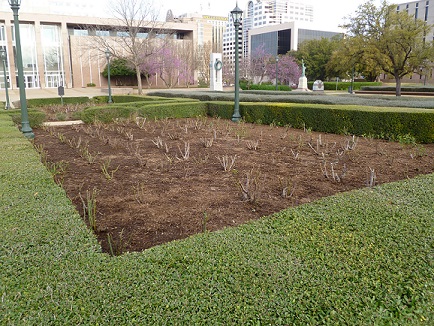
Tyler Rose Garden Winter

Tyler Rose Garden Summer
Weekly Photo Challenge: One Shot, Two Shot

These photographs are contrasts in time.
Winter tree
Summer Tree
Tyler Rose Garden Winter
Tyler Rose Garden Summer
Weekly Photo Challenge: One Shot, Two Shot
I regularly visit the Metropolitan Museum of Art web site, as they have a wonderful online presence. I particularly like their “browse highlights” feature, where they showcase items (over 1,000) in their collections every day. You can view the highlights as a slide show, or you can use the drop down and scroll through at your own pace (that’s what I do).
The Metropolitan Museum of Art has introduced me to works by Wang Hui (1632-1717) from the Qing Dynasty in China, Georges Seurat (France, 1859-1891), Gertrude Kasebier (U.S., 1852-1934), and Helene Schjerfbeck (Finland, 1862-1946), just to name a few.

The Kangxi Emperor’s Southern Inspection Tour, Scroll Three: Ji’nan to Mount Tai (1698) by Wang Hui, in the Metropolitan Museum of Art
The museum includes basic information about each piece. This covers, as much as possible, the artifact name, artist, culture, date, medium, dimensions, classification, credit line, accession number, provenance and description. They also indicate if the artwork is on display. These artworks are not always on display in the museum, which makes me feel special when I can see them on their web site.
Some artworks are purchased from a fund (Rogers Fund, Dillon Fund) or are gifts from individuals (George F. Baker, 1890; J. Pierpont Morgan, 1917; Robert E. Tod, 1937). There are all kinds of ways of how an artwork ends up at the museum, including artists donating their own artwork.
Wait. What? Artists don’t have to be long gone before the Metropolitan Museum of Art will take on their work? No, they don’t. I discovered this when viewing Death, Beauty and Justice V by Raqib Shaw (Indian, born 1974).
And there, in plain sight, the credit line says: Gift of the artist, 2010.
Really? You mean all I have to do is ship off my own artwork to the museum and it will be keeping company with Rembrandt, Van Gogh, Dürer, da Vinci, Kahlo and O’Keeffe? I can see it all now. Name: Fabric Bowl and Lid; Artist: Tresha Barger; Year: 2012; Medium: Rope and cotton fabric; Classification: Fiber Arts; Credit Line: Gift of the Artist, 2013.
Packing tape! Where is my packing tape?! This is exciting, yes? Who knew it was so easy to get my stuff into a museum besides putting it in my purse and lugging it around while I walk up and down the galleries? Oh, but this is serious business. What shall I send? Maybe a Zentangle envelope? A watercolor? A photograph? A table runner, serged scarf, fabric bowl, quilted postcard, pillowcases? Or, here’s an idea, one of each. Yes!
I’m going to need a bigger box.

Poppy? Peony? Pansy? Venus Flytrap?

Dragonfly postcard
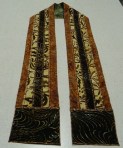
A serged scarf

Texas Capitol and trees with knitted sweaters
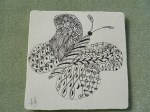
A Zentangle Butterfly

Fabric bowl and lid

Zentangle Hummingbird
This is from the book The Art of Zentangle, 50 inspiring drawings, designs and ideas for the meditative artist.
Hummingbird Zentangle Envelope
A group of vultures is called a wake (when they are feeding), kettle (while in flight), or when resting in trees: committee, volt, venue.
If I’m real still, maybe they won’t notice me.

A vulture venue
Weekly Photo Challenge: Foreshadow
The Romulans have their cloaking device for their warships, developed in the 23rd century (around stardate 1709.21). Wasn’t that a shock when the United Federation of Planets learned about that neat, little trick. To make matters worse, the Romulans got chummy with the Klingons just long enough to trade their cloaking device technical specifications for some D7-class battle cruisers.
Romulans and Klingons 1, United Federation of Planets 0.
There has been enough time travel in the Star Trek universe that the date for the earliest use of a cloaking device gets a little muddy. It may or may not have been in 1986 in the San Francisco area, when a pair of humpback whales were relocated in time by the Enterprise crew in a stolen Klingon Bird of Prey. (Saving the world, yet again.)
Time travel being fraught with circular motions and questions of “What came first: the chicken, or the (chicken) egg brought back in time by who knows who and who knows when?” It’s no wonder that we are a little confused.
In any case, 21st century scientists decided not to wait for Romulan technology (the 23rd century seems so far away, doesn’t it?) and started experimenting with their own stealth technology to cause objects to be invisible to parts of the electromagnetic spectrum. It’s rumored that the British Army has already tested an invisible tank. Notice I said it was a rumor, not a secret. Note to self: If I see a pair of deep, parallel indents being invisibly created looking like something nothing is going from Point A to Point B, do not just stand there; run in the opposite direction!
Just imagine the potential disastrous results of someone with Harry Potter’s invisibility cloak, taking a nap in the San Francisco park and a cloaked Klingon warship lands there or the British decide to invade again with their invisible tanks. Yikes! Note to self: Remove invisibility cloak before nodding off to sleep.
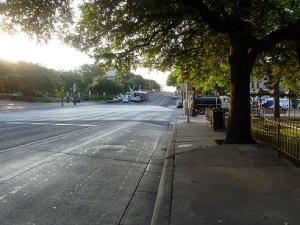
Smooth Sailing
But not so fast. Romulans, Klingons, British Army, Harry Potter, stealth technology scientists, I name you amateurs. Yes, amateurs in the face of the true rulers of cloaking devices: city buses.
Oh, yes, I have named those that should not be named. In all the world, in every village, township, city, metropolis with public transportation, the city buses have perfected the art and science of disappearance and appearance.

An uncloaked city bus
Unsuspecting car drivers are waiting at a red traffic light, thinking that for once, it will be smooth sailing on their drive to work.
They look away for a second — only a second! — maybe at a cute squirrel on a tree limb and then POOF! A city bus now is idling where before there was none.

White city bus
They are everywhere! Big buses, small buses, white buses, blue buses! And the later you are in your commute, the more buses that appear! On a rare occasion, I will feel a change in the air and can see a slight shimmer out of the corner of my eye. When next I blink, there is a bus in front of me, yet again.

Blue city bus
And if I think having a bus appear out of nowhere in front of me is unnerving, I am more than startled to discover one decloaking right behind me.
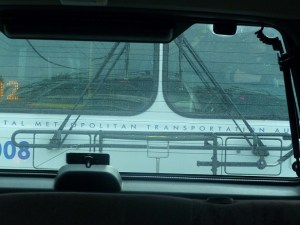
Trapped!
Uh-oh, now I’m boxed in. Maybe I need a cloaking device of my own?

