Auditioning Layouts

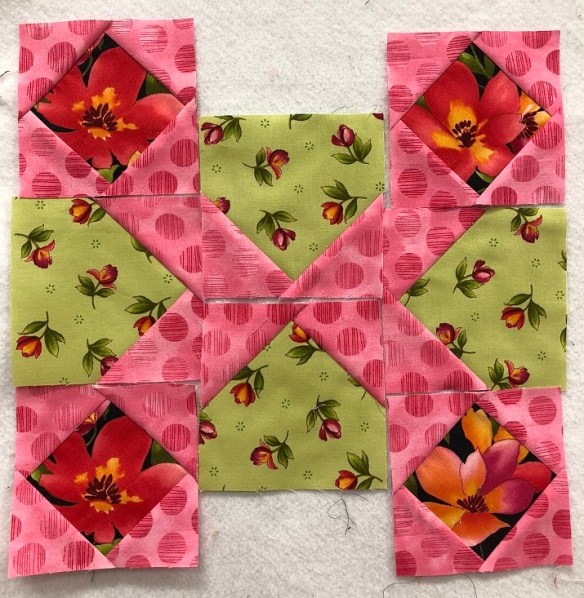
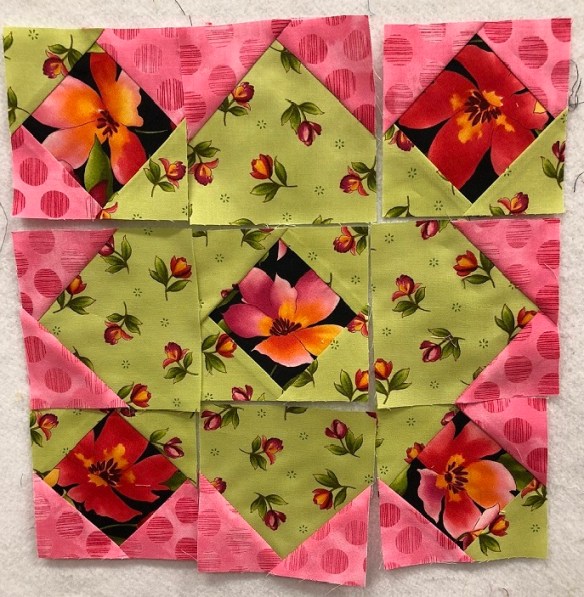
I used Deb Tucker’s Square 2 ruler in a class and made some square-in-a-square blocks and some Little House blocks. I put them up on the class design wall and moved them around to see how they looked. The best thing about the class and the rulers is that my sewing accuracy improved (which is the point).

00s Square 2 (1)

I’m a “whatever” sewist: if my seams are consistent and somehow match up when I sew quilting blocks together, it’s usually an accident. I rarely take out a seam and re-sew it if the corners don’t match, otherwise I’d be there all day just on that one intersection.

00s Square 2 (2)

I’m not in any way affiliated with the Deb Tucker ruler business, I’m just sharing a part of my sewing journey.

Charms on Point

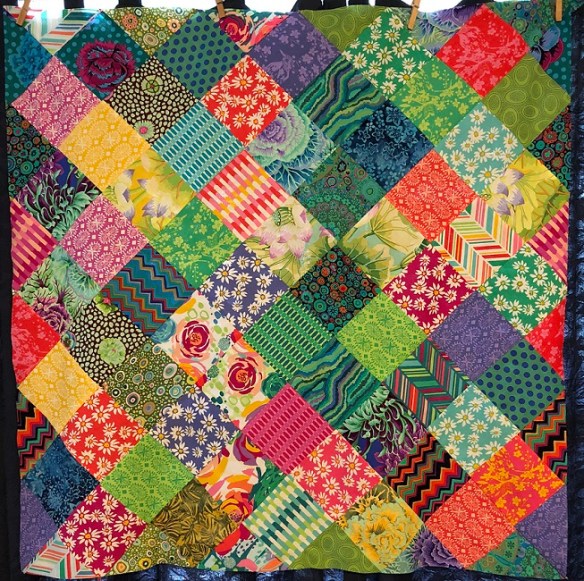
A new quilt pattern for me: Charms on Point. Charms are 5-inch squares of pre-cut fabric. This quilt started out as a rectangle: 6 fabric squares by 12 fabric squares. You make two cuts: from the top middle to the bottom corners, making three triangles. Sew the two outside pieces back together, then sew that piece to the remaining triangle. And there you have it: a quilt with the squares on point. It’s 37 inches by 37 inches. The outside edges are on the bias, so I’ll add a border for stability. I will make another quilt with layer cakes (10-inch pre-cut squares) and see what size that ends up as.

00s Charms on Point

I like scrappy quilts and for this one I used a mish-mash of 5-inch squares from three or four different charm packs. I spent quite some time arranging the rows before sewing them together to ensure the same fabrics didn’t touch each other. After the cutting apart and sewing back together, I noticed I ended up with the two rose patterns right next to each other. Oh, well, better luck next time.

Tumbler Quilt

I saw a sample of this quilt at the Honey Bee Quilt Store in Austin, Texas. I checked my list of rulers that I keep on my smart phone and I already owned the templates. They were a gift from Shelly some years ago. Well, I just had to try it, so I did. It went together fairly easily. Using batik fabrics made it easy as I didn’t have to flip the template over to get a reverse shape. I cut everything out with the template in one position and then I flipped the batik fabric over. I just love it when a plan comes together. It’s at the quilter’s as I write this so it will be ready soon for me to add the binding and then it will be ready to give away.

00s Tumbler quilt

Chinese Alligator #27

For my art quilt homework assignment, I chose a Chinese alligator as my subject.
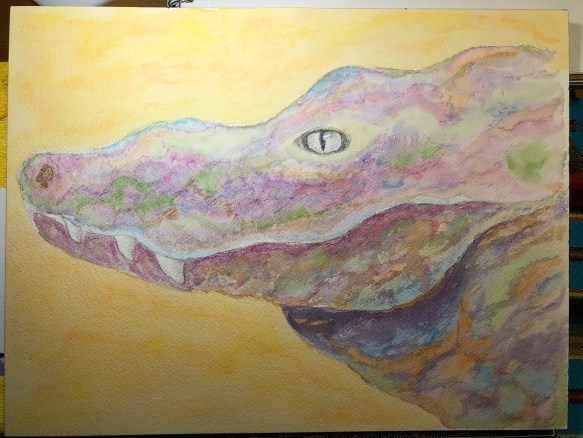
00s Chinese Alligator 27

Chinese Alligator #27

The homework assignment is due in October 2018. That may sound like a lot of time, but I can tell you, it is not. Here’s my plan.

(1) Sketch the alligator on paper (number unknown)
(2) Paint the alligator on watercolor paper (27)
(3) Sketch the alligator on fabric (TBD)
(4) Paint the alligator on fabric (TBD)
(5) Sketch and paint the alligator on fabric, full size, approximately 27 x 34 inches (planned for only once, but we’ll see)
(6) Quilt the alligator (planned for only once, but we’ll see)

Steps 1-4 are studies or prototypes, leading up to the final product. I didn’t track how many times I sketched the alligator for Step 1; lots, that’s for sure.

I just finished Step 2: alligator in watercolor. I numbered these prototypes and I made 26 before I was mostly happy with the result. Most of the 26 prototypes are on 5×7 watercolor paper. I then painted #27 on 300-lb 12×16 watercolor paper. I’m thinking of naming her Mona Lisa or maybe Here’s Looking At You, Kid!

Here is it in black and white, a useful version to determine the level of value changes.
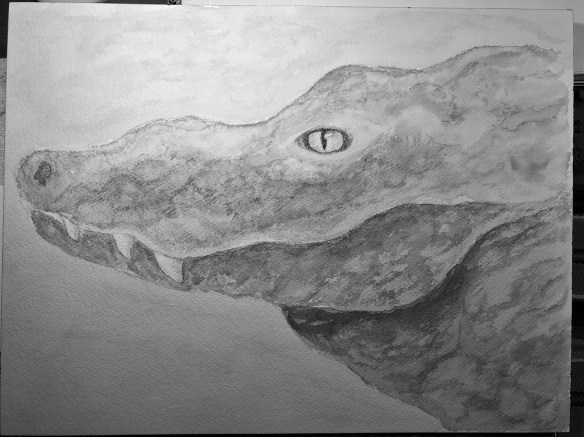
00s Chinese Alligator 27 B&W

This is the photo I’m using as my subject, from Wikipedia. The photo is by Greg Hume. I really like to work off of my own photos, but there wasn’t any way I’d be able to photograph a Chinese alligator. Greg allows this photo to be used as long as he is credited. Easy to do. Thanks a million, Greg!

00s Chinese Alligator by Greg Hume

Photo by Greg Hume (from Wikipedia)

I move on from one step to the next when I am okay with the current result. I’m not waiting for it to be perfect, otherwise I’d never finish. By the time I get to the final steps of sewing, painting, and quilting on the full size version, I will have gained even more experience. I hope the final product looks like the version I see in my mind.

More updates after the next step is finished!