Looking into the Alley Log Cabin, built in 1836.

Alley Log Cabin, Columbus, Texas
Thursday is for doors over at Norm 2.0.

Looking into the Alley Log Cabin, built in 1836.
Alley Log Cabin, Columbus, Texas
Thursday is for doors over at Norm 2.0.
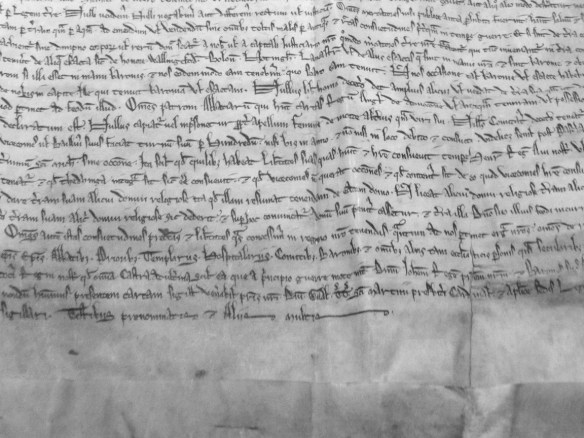
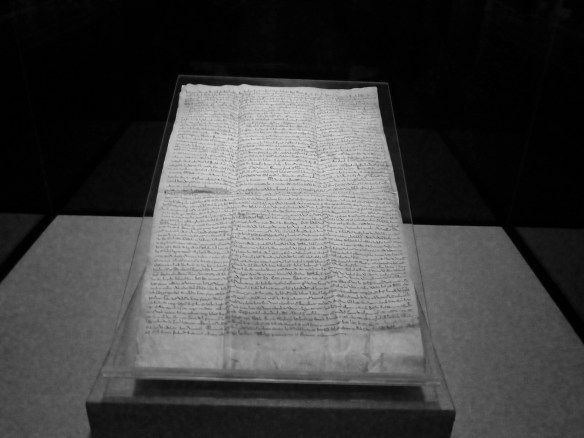
Yes, Magna Carta as in The Magna Carta from 13th century England. There is more than one copy from the 13th century still in existence, as copies were sent to all the corners of the kingdom to make sure everyone knew what was going on. This one was on display at the Houston Museum of Natural Science in May 2014. No, I can’t read it.


Straw decoration sketch
This sketch was surprisingly hard; another one where I just finally stopped erasing, deciding to leave it alone. I fall into the category of “chicken scratch” sketchers. I put down short, quick strokes, lots and lots of them. If I don’t like the first few dozen, I press a little harder and make them darker, as if that’s the problem. Well, that’s one of the problems, but not the problem. While I’m sketching with my right hand, I’m kneading the eraser in my left hand, getting it ready.
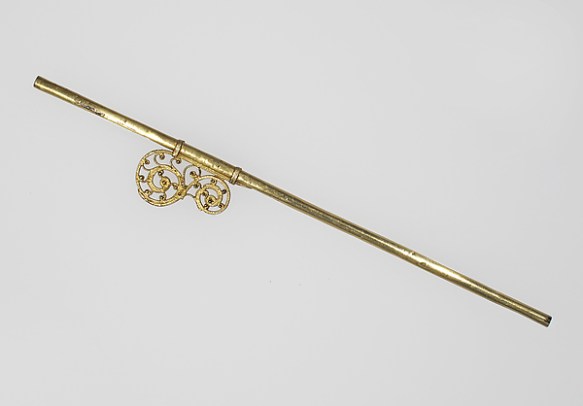
Straw, 1230-1250, German, silver
What fascinates me about this straw is the time frame: 1230-1250. There are a gazillion things in the world that I never took any time to consider, and straws being invented around 3,000 BCE is one of them. If anyone had asked me as to when straws originated, I would have guessed in the 20th century, after plastic was invented. Straws have always been plastic, right? I was wrong, wrong, wrong, about 5,000 years wrong.
Sketch 045: Straw, Metropolitan Museum of Art, The Cloisters Collection, 1947
Friday Fictioneer Challenge: Write a 100-word story based on the photo.
~~~~~~~~~~~~~~~~~~~~~~~~~~~~~~~~~~~~~~~~~~~~~~~~~~~~~~~~~~~~~~~~~~~~~~~~~~~~
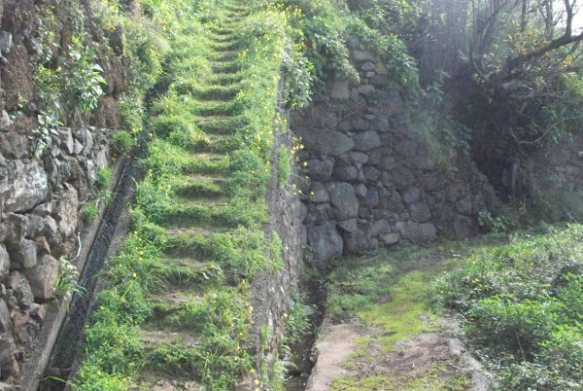
Friday Fictioneer photo prompt. Copyright Bjorn Rudberg
Caledonia
Quintus woke with a vision: The Emperor Septimius Severus would not return to Rome, but would soon take his last breath beneath the northern sky of Britannia.
At dawn, Quintus broke his fast at his post on the Antonine Wall. His vision weighed heavily on his mind, for dangerous times followed an emperor’s death. He knew Rome was lost to him forever. Fleeing was risky; staying possibly even more so. To the north lay Caledonia, the only land not under Roman rule.
The next sunrise found his post abandoned, but with the news of the emperor’s death, no one noticed.
~~~~~~~~~~~~~~~~~~~~~~~~~~~~~~~~~~~~~~~~~~~~~~~~~~~~~~~~~~~~~~~~~~~~~~~~~~~~
~~~~~~~~~~~~~~~~~~~~~~~~~~~~~~~~~~~~~~~~~~~~~~~~~~~~~~~~~~~~~~~~~~~~~~~~~~~~
The photographer is Bjorn Rudberg and his story is The Emigrant.
 It's a long story ...