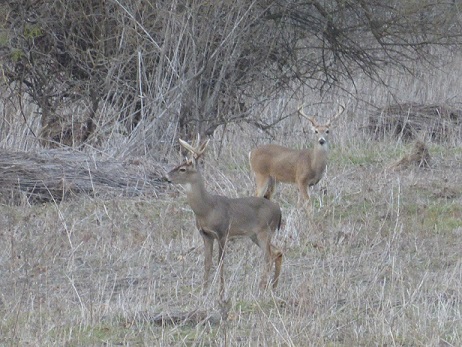
Saw these young bucks near Buda, Texas. There were about seven of them hanging out.
Young bucks

Saw these young bucks near Buda, Texas. There were about seven of them hanging out.
Young bucks
I recently saw a photo of a trail in the Brazos Bend State Park. Trees with hanging moss lined the trail and I thought, “How pretty. I’d like to go there.” In looking it up on the Texas Parks and Wildlife web site, I find out that it has 4,897 acres, six lakes, a nature center, an observatory, and miles and miles of hiking, biking and equestrian trials.
And alligators.
One recommended hike is the 40-Acre Lake Trail, which is “an excellent way to view wildlife, including the American Alligator.” Really? I think an excellent way to view any alligator, American or otherwise, is from far enough away that it won’t consider me as part of their food chain. I’m not sure what distance that is, but I’m pretty sure it’s not up close and personal.
In fact, the Brazos Bend State Park has put together an Alligator Etiquette list of do’s and don’ts for visitors:
• ABSOLUTELY DO NOT FEED OR ANNOY THE ALLIGATORS.
• Keep pets on a leash no longer than six feet. Do not throw objects in water for your dog to retrieve.
• Keep at least 30 ft. from an alligator – do not assume they’re slow-moving.
• Do not swim in or wade into any water in Brazos Bend State Park.
• If an alligator goes after a fish you have caught, cut the line and let the alligator have the fish.
• Avoid any alligator sunning itself in the middle of the trail or lake bank.
• Stay clear of grasses, twigs and/or soil near the side of a trail: it may be a nest and the mother alligator is probably close by guarding it.
• If an alligator opens its mouth and hisses, you have come too close. Retreat slowly; make no quick moves. Keep your eyes on the alligator.

Can you hear me now?
Interesting that the list is directed towards humans and not the alligators. Don’t they have to take any responsibility here? Apparently not. I suppose “Alligator Etiquette” is a catchier name than something like “How Not To Be Stupid Around Deadly Native Animals While Traipsing Through Their Home Territory.” I particularly like the advice about letting the alligator have a fish that you caught. I mean, if an alligator has that fish in its mouth, it’s invoking the “possession is nine-tenths of the law” playground rule. You want to contest that one-tenth, saying you went to all the trouble to catch that fish and it’s yours? Not a good idea.
Those moss covered trees sure are pretty at Brazos Bend, but I’m thinking a visit to the northernmost state park might be first on my list, the alligator-free Palo Duro Canyon State Park.
(The Texas Parks and Wildlife agency is happy to let everyone know that the 90+ Texas state parks are open during the federal government shutdown.)
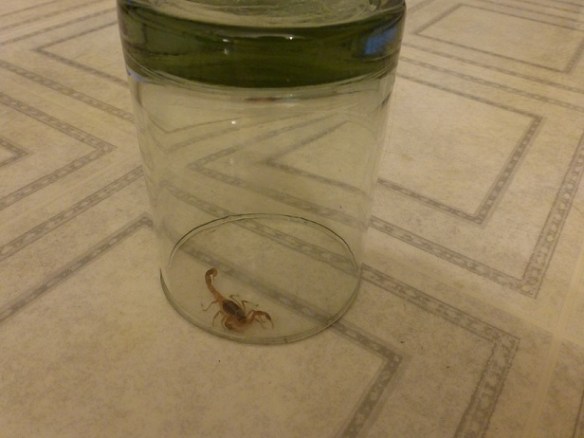
This scorpion and I were not happy to see each other last night. I captured it with a glass, relocated it far away from the house and washed the glass to remove the scorpion cooties.
I have no problem wishing it a long and happy life, from a distance.
Trapped!
Need a hat? Garden-ville in Creedmoor has quite a selection for you.

A hat for all seasons and reasons (gardening, dancing)
They also have a few cats (not for sale). Here’s one, subtly keeping track of our movements.

A shop cat
Dogs are fascinated with wiggly, squiggly things, snakes included. Over the years, we’ve had seven rattlesnake bites to our dogs. Fortunately, none died from the bites. There are a lot of variables in a rattlesnake bite that go into a dog’s chances of surviving: the amount of venom injected (not all bites inject the same amount of venom), the age and size of the dog, the site of the bite, the treatment (if any is given). Our dogs are always up-to-date on the vaccine for the Western Diamondback Rattlesnake, developed by Red Rock Biologics. (A dog so vaccinated still needs professional care, if bitten.)
For the dogs, the rattling sound is a big “Over Here!” signal, just opposite of what the snake is saying. One dog will rush over to the sound and the other dogs, who notice that the first dog is in hunt mode, scramble over to huddle and nose their way in, trying to ensure they are not left out of any potential predatory activity.
Even when the snake has moved away (or has been dispatched by other methods), the dogs will hunt that specific spot as long as they can smell something. Once any remnant of odor is dissipated, however, that spot becomes a normal part of the landscape and they ignore it unless a new attention flag is raised.
Not for me, however.
Although we’ve had seven rattlesnake bites to our dogs, we’ve come across more than seven rattlesnakes. And even though the rattlesnakes either get away or they don’t, I always remember where they were. Unlike the dogs, I check that spot forever and ever. It doesn’t make much sense doing that, as there is no law of nature that says snakes can only be found in a given location. In this regard, I am as bad as the dogs. Worse, really, as I never drop a specific rattlesnake location off of my radar. It’s emotional and illogical, I know.
Now when I go out the back door, I peek around the corner . . . just in case.

There was a snake there . . . once.
Clint was bit by a snake on the back porch. It’s free of snake hiding places (mostly).
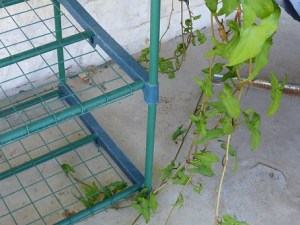
Is that a plant or a green snake?
I had to pull back the dogs as they had a rat snake cornered here; not a poisonous snake, but large (5 feet long?) and dangerous nevertheless. I had to use the homemade snake noose to relocate the snake to the front pond, apologizing the whole way.

A cornered snake is an unhappy snake
Poor Yoda got bit twice, four years between the first bite and the second. The second bite was in the dog pen, only a few hours after we got home from the vet, getting the dogs their rattlesnake vaccine. We think the vaccines help.

A snake location in the dog pen
And then there is everywhere else a snake can be, and has been, found. One does not just sit down at the picnic table in our yard. First there is the reconnaissance circle around the table, then peeking underneath for wasps. It’s always something.

Yes, even under the picnic table.
I’m hoping we don’t have any more rattlesnake sightings. I have enough places on my checklist and it takes me longer and longer to get from Point A to Point B. Unrealistic and illogical, but that’s they way it is.
 It's a long story ...