Things change, to state the obvious. Some changes are not obvious, however. They happen outside of our visual range, we’re not kept in the loop, or there is no “loop” mechanism. When we discover a change, it’s sometimes startling.
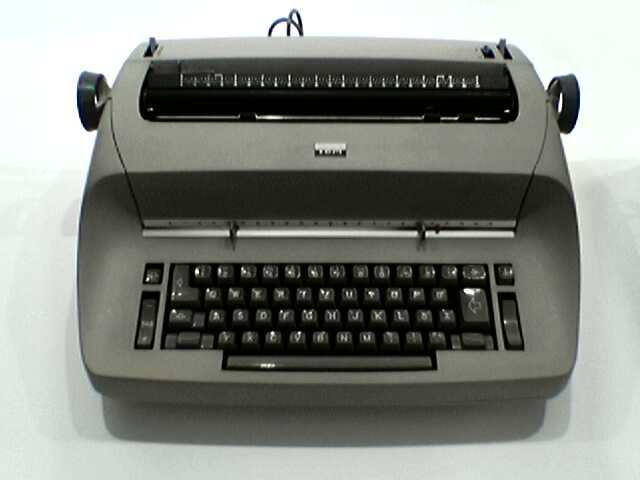
In 2008, one such change caught up with me. It was during a discussion about punctuation and a co-worker mentioned that the standard was to use one space after the end of sentence, not the two spaces that I learned way back when. (I still remember that IBM Selectric in my typing class.)

IBM Selectric
Really? One space and not two? The change was one surprise, the idea that the change had been in effect for several years without me knowing was another surprise. How does one find out these things?
One way is to keep up with writing guides, which I hadn’t been doing. It never occurred to me that punctuation might change. Now I know.
And now I have a copy of the Associated Press Stylebook; one copy at the office, one at home.

Associated Press 2012 Stylebook
With this in hand, I was aware — in a timely manner — of another change: Hopefully.
In 2008, the year of my first AP Stylebook, this is the entry for hopefully: “It means in a hopeful manner. Do not use it to mean it is hoped, let us hope or we hope. Right: It is hoped that we will complete our work in June. Right: We hope that we will complete or work in June. Wrong as a way to express the thought in the previous two sentences: Hopefully, we will complete our work in June.”
In 2012, the Associated Press changed their entry and accepts hopefully in its current, popular usage. Their new entry: “The traditional meaning is in a hopeful manner. Also acceptable is the modern usage: it’s hoped, we hope. Correct: “You’re leaving soon?” she asked hopefully. Correct: “Hopefully, we will be home before dark.”
I knew that the hopefully usage was hotly debated among grammarians. Some accepted the modern usage, others railed against it. Any time I used hopefully verbally, I felt guilty. I was careful in my writing not to use it in the “I hope” manner.
Its usage is still debated, but the tide has turned towards accepting its modern usage. There’s no going back. Now you and I can breathe easy when we use it.
So here’s my wish for the new year, 2013. Hopefully, the changes we will see will be for the better. A lot of good things happen every year, a lot of bad things happen every year. I am hopeful that the good will outweigh the bad.


 It's a long story ...