Weekly Photo Challenge: Treasure

Mother Nature’s treasures.

Blue Jay in winter

Blue Jay in winter

~~~~~~~~~~~~~~~~~~~~~~~~~~~~~~~~~~~~~~~~~~~~~~~~~~~~~~~~~~~~~~~~~~~~~~~~

A treasure for me: an independent bookstore. There are several in Austin. BookPeople is my favorite.

BookPeople

BookPeople

~~~~~~~~~~~~~~~~~~~~~~~~~~~~~~~~~~~~~~~~~~~~~~~~~~~~~~~~~~~~~~~~~~~~~~~~

I also appreciate the people who created the hot spot technology. We are on Day 16 without our regular Internet service. They are waiting on a part for the tower. I’m considering starting a crowd-funding campaign so they can buy a 3D printer and make their own parts.

On Tour

A couple of years ago, I drove to Houston to see author Patti Digh at a bookstore. She was on tour, promoting her book, Creative is a Verb. Although not what I usually consider “in the area,” Houston was the closest tour stop and so I decided to head on out to the Big City (as I call Houston) to see Patti. I picked up my friend, Judy, in Brenham and off we went.

I have three pieces of artwork in two of Patti’s books (Four Word Self Help and Creative is a Verb), and she had requested that people bring their artwork so she could see them in person. Woo-hoo! This meant that I was also “on tour” with my artwork.

Actually, I go “on tour” all the time. My tours are nothing like Patti’s (or any other author or artist, for that matter). I don’t go out of town and I don’t have anything for sale. My tours are self-arranged and self-promoted and are limited to the people I can hunt down at the office work with.

I’m an early bird and often the first one to park in the garage and the first one in the office (sometimes before 6:00 a.m.). But as a true artist, I don’t let that little detail get in my way. I start my tour right away, before I even get to my desk. First stop is the security officer. “Ben,” I say, “look what I have!”
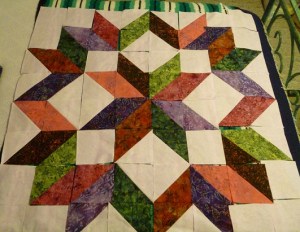
Quilt top blocks for the Carpenter's Star pattern, arranged on top of my bed

Carpenter’s Star, arranged

No matter what I bring in, a 4×6 quilted postcard, a watercolor or acrylic painting, a quilt top, Zentangle envelopes, pillowcases, table runners, miniature art quilts, pencil drawings, blouses, wallets, or tote bags, Ben is appropriately appreciate. I cannot tell you how good it is to start a tour with a positive reception; it makes all the difference in the world.

I then have a break in my tour schedule, as I wait for my office mates to trickle in over the next few hours. I check the clock regularly, gauging how much time they need to settle in before I show up at their cubicle with my stock statement, “I have show and tell!”

My first watercolor painting: sunflowers in a terra cotta vase

Look! I’m an artist!

When it’s time, I announce — to no one in particular — that I’m going “on tour.” My scheduled stops include my division director, several department heads, all the administrative assistants on my floor, the credit union lady, a few more security officers, as well as my quilting block-of-the-month cohorts.

Once I’ve exhausted the captive audiences in my building, I head on over to the annex for three more floors of potential artwork admirers. I usually take the catwalk between the main and annex buildings and anyone standing in the catwalk taking a break gets drawn involuntarily into my showing and telling. The same goes for anyone who gets on an elevator with me: I consider them fair game.

A fabric postcard, crazy quilt with a dragonfly in the center

Dragonfly postcard

It has happened, on occasion, that I’ve been on tour right before a meeting and didn’t have time to take that day’s masterpiece back to my desk. No problem — for me, at least — as I take the artwork with me. Ah, a new audience. As they arrive, I tell the meeting attendees, “This will only take a minute,” and then I show them.

Sometimes I’ve been lucky enough to have appointments away from work on show-and-tell days. After I sign in, I bring out my artwork to share. My dentist’s office (the receptionist, dentist, dental assistant and hygienist), my physical therapist and his assistants, I make sure to include them all.

No one, but no one, is safe from me when I have show and tell.

General Reader

Non-professional reader, general reader: two terms I came across recently in books that I read that described the book’s audience.

I think they are talking about me.

I found the “non-professional reader” term in the acknowledgements for The Peloponnesian War by Donald Kagan, about the three decades of war between Athens and Sparta (with a cameo appearance by the Persian Empire), 431-404 BC.

The Peloponnesian War

The Peloponnesian War

The “general reader” term came from Your Brain on Cubs, Inside the Heads of Players and Fans, a compilation of scientific essays edited by Dan Gordon of the Dana Foundation. From the front inside book jacket: “The contributors to Your Brain on Cubs introduce us to the role of the brain, not just in these emotions, but in many aspects of watching and playing sports.” “Emotions” referring to “a come-from-behind win and the equally powerful crush of a disappointing loss.”


Your Brain on Cubs

Your Brain on Cubs

After thinking about it, I came up with my own definition of “non-professional reader” and “general reader”: A reader who is not a specialist in the field of a book’s subject.

Okay, now I know they are talking about me. I’m not a historian or a scientist, but I seek out books in those (and other) fields.

What was most fascinating to me about the Peloponnesian war is that the leaders of Athens and Sparta, Pericles and King Archidamus II, respectively, did not want to engage in war, yet it happened anyway. After three decades of war [spoiler alert], Athens surrenders. Sparta’s reigning regime is relatively short-lived, however, as a few years after that, Philip II of Macedon comes along and conquers both of them (and a whole lot more) and his son, Alexander the Great continues the empire’s expansion. So much for the Greek independent states.

And while it took about 30 years for Sparta to conquer Athens, the Chicago Cubs haven’t won a World Series title since 1908. I had great hopes for them in the 2008 season (the Cubs, not Athens or Sparta), thinking they could win on their 100-year anniversary. Didn’t happen, but I haven’t given up.

The first essay in Your Brain on Cubs is The Depths of Loyalty, Exploring the Brain of the Die-hard Fan by Jordan Grafman, Ph.D. I’ve never met Dr. Grafman, yet there I am in his essay. Another essay, Baseball and Handedness by Kenneth M. Heilman talks about left-handedness, right-handedness, along with left-eye and right-eye dominance. What does it all mean? Turns out, it means a lot in how and when a batter sees the pitched ball and its trajectory towards home plate.

The Forest Unseen book cover

The Forest Unseen

Fascinating, just fascinating. So to all the historians, scientists, and other specialists out there: Keep writing for me! I’m reading as fast as I can and I’ll get to your specialty soon!

Now that I think about it some more, I just love being a non-professional, general reader. My next book in the general reader category: The Forest Unseen, A Year’s Watch in Nature by David George Haskell. Looking forward to it!