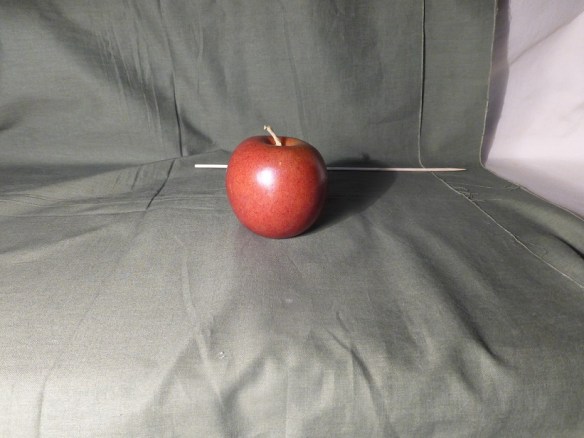
The Dreaded Red Delicious Apple

In my art class, there is a fake Red Delicious Apple. Sketching it gives me fits. It’s a dark object, so there are only four tones (6-10) that can be used, other than the tiny spot where the light hits it.

The sketch of the red delicious apple

Mostly looks like the apple

My bright idea was to buy one, one with as many contours as possible, and sketch it at home.

The red delicious apple to sketch

The dreaded sketch object

For most of the time, in my sketch it looked like a bell pepper. I worked on it until I didn’t know what else to correct. That’s always my stopping point.

Red Pear in Charcoal

It took me a long time after starting art classes to try it sketching at home: about seven months, elapsed time (calendar time was longer, but with some breaks). In class, I struggled — and continue to struggle — with line drawings and tone. I finished the line drawing and tone courses and went on to the beginning oil painting course. One effort there and I knew I wasn’t ready, so I chose to return to the drawing and tone courses.

I could understand what my instructor explained when going over the steps: identify the tones, sketch large to small, triangulate, review and correct as necessary. Yes, I understood as long as she was demonstrating these aspects at my station, but as soon as she went to help another student . . . Poof! My understanding evaporated and back I went to sketching loopy dark globs. For a while I considered not even trying to accurately represent an object, but to announce that I was following in the footsteps of Salvador Dali or Picasso (in his Cubism phase). I am pretty sure neither of them would have been happy to hear that, so I continue my efforts to learn what my instructor teaches.
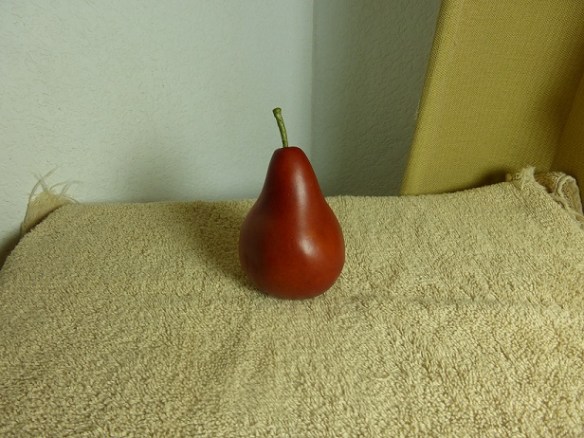
A plastic red pear as my sketching subject in what I call my home studio: the corner of my dining room

Red pear at my home “studio:” the corner of my dining room
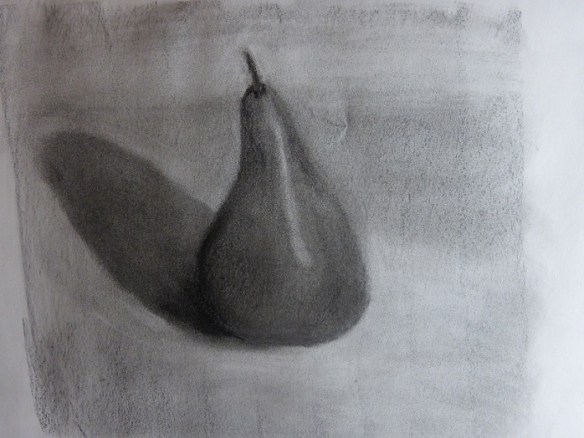
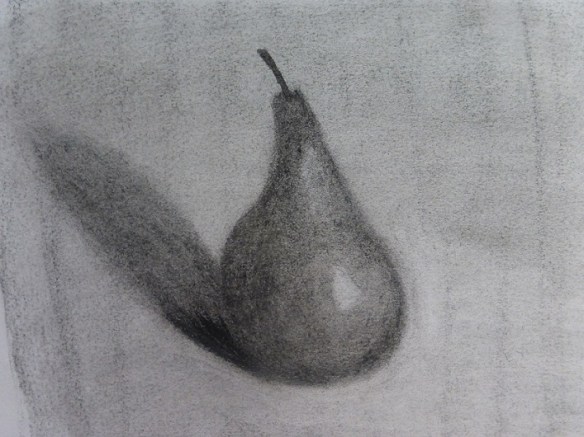
First sketch of the red pear

Red pear, sketch 1

How many times did she tell me that a cast shadow cannot be all one tone? I don’t know and I’m pretty sure she’s not finished reminding me. (Oh sure, I can remember that when I’m writing . . . )

Once I went back to charcoal sketching, I knew it was time to start sketching at home. Scary stuff. About this time, I came across the OneDrawingDaily blog, and I was inspired. I haven’t done one drawing a day, but I’m working on it.
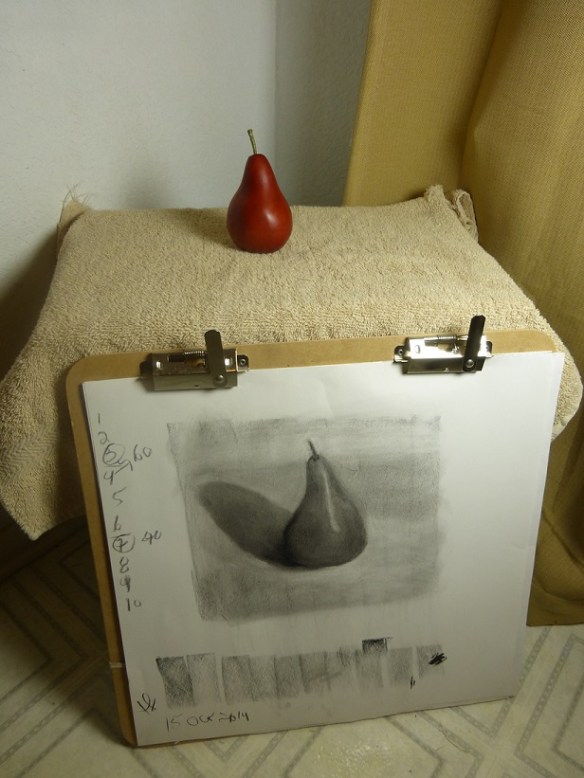
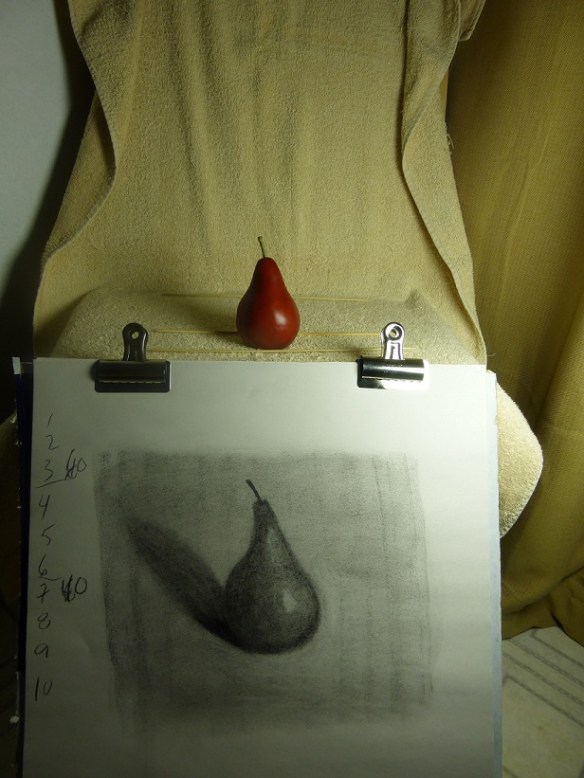
The red pear and sketch together in a photograph.  The sketch mostly looks like the red pear, but not totally.

My sketch mostly looks like the pear


~~~~~~~~~~~~~~~~~~~~~~~~~~~~~~~~~~~~~~~~~~~~~~~~~~~~~~~~~~~~~~~~~~~~~~
My first pear sketch was okay, but something was off. I couldn’t figure out what to correct, so I tried it again.
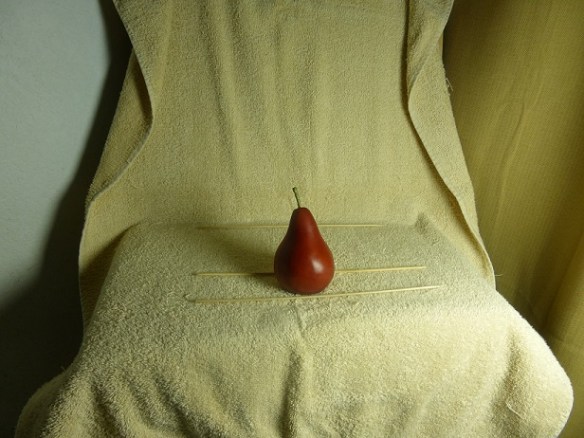
The red pear again, for my second sketch

Practically deja vu

My second effort at sketching the red pear.  A better result.

Sketch #2, better

Red pear and sketch #2 together to see how I did.  Sketch #2 is much better, I think.

All together now

Even in the few sketches that I’ve done (two pumpkin sketches, two red pear sketches), I think I’m starting to understand tone and line. And I can believe that as long I don’t show the sketches to my instructor, right?

Not The Great Pumpkin

‘Tis the season. Pumpkin sketching season, that is.

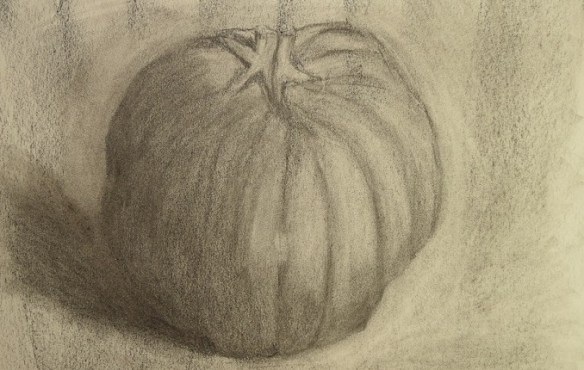
My first sketch. Looks like a pumpkin. Or what I think a pumpkin looks like; just not like the pumpkin I was looking at, so I abandoned the sketch.

A sketch of a pumpkin

Recognizable as a pumpkin

The real pumpkin.

The pumpkin as a model for my sketch

Pumpkin model

My second effort. And there is something funny about this one. The real pumpkin is a little lopsided but my drawing doesn’t reflect it accurately. Usually it’s the other way around: my drawing is lopsided and the model objects are not. I’m looking forward to the time when my drawings match the model shapes. Won’t that be something to celebrate.

Another pumpkin sketch, second try

Second try

This was only my second independent (not in class) sketching effort.

Three-Hour Apple

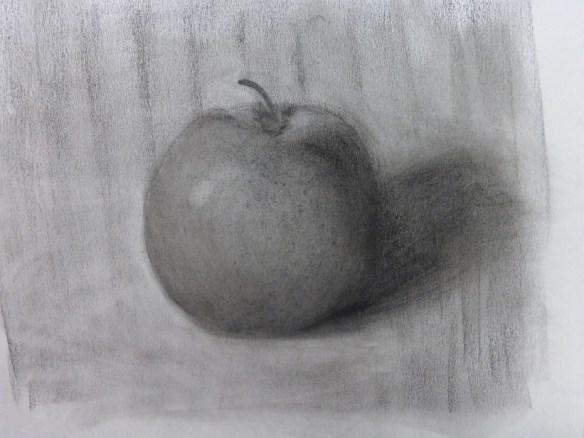
After struggling with my first oil painting, I realized that I don’t know enough about tone. I returned to using charcoal and sketched an apple. I spent three hours on this apple. I think it’s recognizable as an apple, but not necessarily the apple I used as my subject. Sigh.

A charcoal sketch of an apple

Yes, that’s an apple

The bamboo skewer is there to point out to me where the top of the shadow is relative to the top of the apple. (From where I sat when I sketched the apple, the shadow was lower than how it looks in the photo.) When I first sketched the apple, the shadow was much higher. Why? I don’t know.

An apple, with a bamboo skewer behind it marking the top of its shadow

Seems straightforward enough

My first problem was that I shaded my background way too dark (I laid down a 6 tone and it should have been a 4) and then had trouble distinguishing the dark tones of the apple and its shadow (tones 6-10). The instructor put a 6-tone fabric under the apple to help me see the difference in a 4 tone and a 6 tone. You can barely see the lighter fabric in the top right corner of the photo.

The tone chart goes from light to dark. I know that 1 is white and 10 is black. I might even be able to put down on paper a correct likeness of 2 (one tone darker than white) and 9 (one tone lighter than black). But talk to me of a 4, 5 or 6 and I will not be able to mass it in correctly.

What did I do in that three hours? I sketched in the apple, put in tones . . . and then erased them. I did this several times trying to get the shape and tones of the apple correct, as well as the shape and the tones of the shadow. I’m getting really good at erasing.

I’m choosing to work on tones in charcoal a while before my next oil painting effort. We’ll see how long that takes.

Photography Homework: Lunchtime

These are the photographs that I turned in for my Class 3 photography homework assignment. Both my subjects happened to be eating, so I categorized them as “Lunchtime.”

This is Madison having lunch. I saw her and her mother at an adjacent table just as I was leaving a sandwich shop. I asked for permission to photograph the baby and the mother was gracious and agreed.

Madison, a baby, being fed lunch by her mother

Yummy


~~~~~~~~~~~~~~~~~~~~~~~~~~~~~~~~~~~~~~~~~~~~~~~~~~~~~~~~~~~~~~~~~~~~~~~~~~~~~

This is an Argiope aurantia spider, also having lunch. I found the spider while taking photos of a Texas Wood Lizard in my back yard and decided the spider would make a good subject for my homework.

A spider, an Argiope aurantia, eating a cricket

Yummy, in a Mother Nature food-chain way

I must have made at least 11 trips out to the spider web, trying to get a good photo. I was (am) having trouble with my photos being over-exposed. I’d trek out to the web, take seven or eight photos, come back into the house and review them on the computer monitor. Result: Over-exposed. Back out to the spider web. I finally got this one photo that I thought was decent enough to share.

But I’m telling you, if that spider had flinched while I was looking through my camera viewfinder, I would have high-tailed it out of there. It was an overgrown area and I wasn’t thrilled about being there anyway. I was a few inches from an ant mound and I heard rustlings in the tall grasses behind me. If a cricket had landed on me, I would have panicked. If a fire ant had bit me while I was standing there, I’d have had a conniption fit.

Once I thought I saw the spider eyeing me and I started to fret. I didn’t want it to get any ideas about wrapping me up in its web, thinking if it could just catch me, it would be set for life.

I managed to emerge from my photographic safari in the pasture with only a few dozen chigger bites. How lucky can I get.