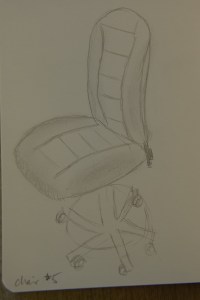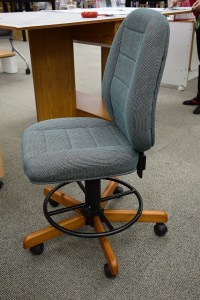
I took a serger class at Sew Much More (Austin, Texas) earlier today. They provide these wonderful chairs for the students. I’d love have such a chair, but that won’t happen as long as I spend all my money on fabric!
Sketch 091: Sewing Chair
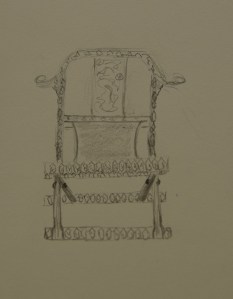
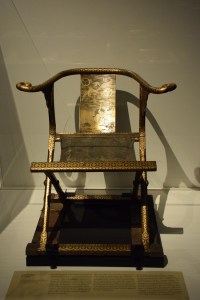
A straight-on view is not such a good one for sketching. That’s not what I had in mind when I photographed the chair. The Samurai exhibit allowed photos without flash. I used a high ISO, which meant a slow shutter speed, which led to blurry photos as I could not keep the camera steady enough for a clear image. This chair photo is about the only exhibit photo I took that wasn’t blurry.

Kyokuroku (folding chair), Japan, 17th century; wood, gold, silver, gilded copper, leather, silk, silk brocade, lacquer
Sketch 090: Foldable Chair in the Samurai Exhibit at the Houston Museum of Natural Sciences. Artifacts are on loan from the Stibbert Collection, Italy.
I sit in Irene’s chair while she styles my hair. Soon she will be moving back to Ireland. (Sob!) I’ve known Irene about 25 years.
Her moving to Ireland might not be such a bad thing. I can visit, right? I’ll give her a little time to unpack and settle in before I show up . . . maybe a week?
Sketch 089: Irene’s Chair
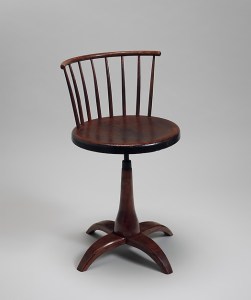
Description from the Metropolitan Museum of Art:
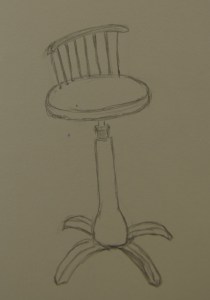
Revolving chairs, also known as stools or swivel chairs, were produced by Shakers in many styles and sizes. The earliest examples stood on long legs and often were used in the brethren’s shops. Low revolving chairs, such as this example, with Windsor-like comb backs were rarely made before 1840.
Sketch 088: Revolving Chair, Metropolitan Museum of Art, Friends of the American Wing Fund, 1966.
I sketched the chair seat a couple of times, working on the angle. I still think it’s off a bit.
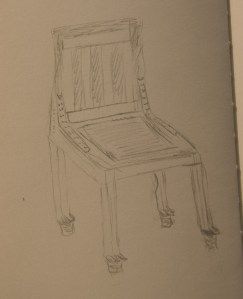
Description from the Metropolitan Museum of Art:
The back of this wooden chair, which belonged to the scribe Reniseneb, is handsomely veneered with ivory and embellished with incised decoration showing the owner seated on a chair of identical form. It is the earliest surviving chair with such a representation, and it is the only non-royal example known. The scene and accompanying text have funerary import and may have been added following Renyseneb’s death to make the chair a more suitable funerary object. The high quality of its joinery and the harmony of its proportions testify to the skill of ancient Egyptian carpenters. The mesh seat has been restored following ancient models.
Sketch 087: Chair of Reniseneb, Metropolitan Museum of Art, Purchase, Patricia R. Lassalle Gift, 1968
It’s been two weeks since I used an artifact from the Metropolitan Museum of Art for my sketches. I wonder if they missed me.