Kindness is a language that the deaf can hear and the blind can see. ~ Mark Twain
Kindness
Reply

Kindness is a language that the deaf can hear and the blind can see. ~ Mark Twain
I went to the dentist for my regular checkup. The good news: No new cavities. The bad news: A cracked tooth.
“Are you sure?” I ask the dentist. Yes, he’s sure.
He asks me, “Does it hurt when I do this?” TAP TAP TAP “No, that doesn’t hurt,” I say.
“Are you sure?” he asks. TAP TAP TAP “Usually people have pain when they have a cracked tooth.” TAP TAP TAP
Bad luck: a cracked tooth. Good luck: not cracked enough to cause me pain.
I schedule two more visits and get a crown on top of my cracked tooth. As he’s cleaning up, my dentist mentions that there’s a 50-50 chance that the tooth is damaged enough that it will also need a root canal. I cup my hand over my cheek so the tooth cannot hear him. “Don’t listen,” I whisper to my newly crowned cracked tooth, “he’s talking about other teeth, not you. Don’t listen to him.”
About three weeks later, I’m congratulating myself on a crown without any post-installation pain. I am on my way to forgetting that ever happened. You know what’s next, right? That’s right, a few days after my celebration, my tooth starts hurting. I ignore the pain on Wednesday. The tooth is just unsettled, I tell myself. On Thursday, I decide that it is definitely unsettled and it is not going to settle down. I call the dentist office and ask for advice as to what to do over the upcoming three-day weekend if the pain worsens.
They work me in for a look-see (4th visit). TAP TAP TAP “Does it hurt when I do that?” he asks. “WELL BY GOLLY YES IT DOES!” I need a root canal. Rats!
I schedule an appointment for a root canal. As it turns out, this root canal will take three visits. “You’re joking, right?” I ask. No, he is not joking. The first one is to drain out the infected gunk (5th visit). (Ick.) Second is to drill out the roots (6th visit). Third is to plug up the roots (7th visit).
I decide that if I’m going to be spending so much quality time with my dentist and his assistant, I should get something for it, something not painful, I mean. They can start a new tradition: Patient of the Quarter. A Wall of Fame, if you will, of patients who spend a lot of time in Chair Number 3. I announce that I will be the first Patient of the Quarter and take my own picture.
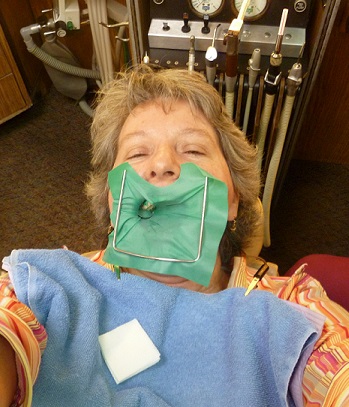
Patient of the Quarter
Just imagine being called into the back and seeing a slew of photos of Chair Number 3 patients, each with a gaping maw of green plastic. Each of us will have our photo taken while in The Chair, making it easy for the dentist and his assistant to recognize us. “Oh yes,” they’ll murmur as they pass by, “I remember her: Tooth #3, a classic case of cracked tooth, crown, root canal.”
I appreciate modern dentistry, I really do. I just wish I didn’t need so much of it.
First watermelon of the season from hubby’s garden. He is one proud papa!

Soon it will be picnic time.
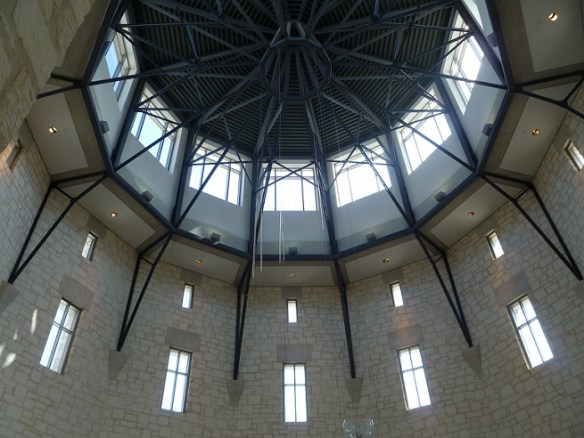
Austin Convention Center, inside the south entrance

Old school, new school

Shadow stripes

Giant Leopard moth on the Texas Capitol grounds
Weekly Photo Challenge: Pattern
Non-professional reader, general reader: two terms I came across recently in books that I read that described the book’s audience.
I think they are talking about me.
I found the “non-professional reader” term in the acknowledgements for The Peloponnesian War by Donald Kagan, about the three decades of war between Athens and Sparta (with a cameo appearance by the Persian Empire), 431-404 BC.
The Peloponnesian War
The “general reader” term came from Your Brain on Cubs, Inside the Heads of Players and Fans, a compilation of scientific essays edited by Dan Gordon of the Dana Foundation. From the front inside book jacket: “The contributors to Your Brain on Cubs introduce us to the role of the brain, not just in these emotions, but in many aspects of watching and playing sports.” “Emotions” referring to “a come-from-behind win and the equally powerful crush of a disappointing loss.”

Your Brain on Cubs
After thinking about it, I came up with my own definition of “non-professional reader” and “general reader”: A reader who is not a specialist in the field of a book’s subject.
Okay, now I know they are talking about me. I’m not a historian or a scientist, but I seek out books in those (and other) fields.
What was most fascinating to me about the Peloponnesian war is that the leaders of Athens and Sparta, Pericles and King Archidamus II, respectively, did not want to engage in war, yet it happened anyway. After three decades of war [spoiler alert], Athens surrenders. Sparta’s reigning regime is relatively short-lived, however, as a few years after that, Philip II of Macedon comes along and conquers both of them (and a whole lot more) and his son, Alexander the Great continues the empire’s expansion. So much for the Greek independent states.
And while it took about 30 years for Sparta to conquer Athens, the Chicago Cubs haven’t won a World Series title since 1908. I had great hopes for them in the 2008 season (the Cubs, not Athens or Sparta), thinking they could win on their 100-year anniversary. Didn’t happen, but I haven’t given up.
The first essay in Your Brain on Cubs is The Depths of Loyalty, Exploring the Brain of the Die-hard Fan by Jordan Grafman, Ph.D. I’ve never met Dr. Grafman, yet there I am in his essay. Another essay, Baseball and Handedness by Kenneth M. Heilman talks about left-handedness, right-handedness, along with left-eye and right-eye dominance. What does it all mean? Turns out, it means a lot in how and when a batter sees the pitched ball and its trajectory towards home plate.

The Forest Unseen
Fascinating, just fascinating. So to all the historians, scientists, and other specialists out there: Keep writing for me! I’m reading as fast as I can and I’ll get to your specialty soon!
Now that I think about it some more, I just love being a non-professional, general reader. My next book in the general reader category: The Forest Unseen, A Year’s Watch in Nature by David George Haskell. Looking forward to it!

