April is, I’m told,
The month to write poetry.
How hard can it be?

Yellow flowers at the Lady Bird Johnson Wildflower Center
NaPoWriMo (National Poetry Writing Month)

April is, I’m told,
The month to write poetry.
How hard can it be?
Yellow flowers at the Lady Bird Johnson Wildflower Center
NaPoWriMo (National Poetry Writing Month)
A favorite activity of mine is to write letters and postcards. Over the years, I’ve discovered I have definite preferences for pens, paper and envelopes. For pens, a ball point works best for me; fine or extra fine point, in three or four different colors, of course. I like rollerball pens, but my handwriting gets just a little too free form and my hand has a tendency to zoom off the page when I least expect it. (Now that’s an odd phrase: “when I least expect it” as I’m never expecting it, whatever “it” is.)

Up and to the right
My handwriting has a tendency to go up on the right side of the page. It’s a strange looking letter that my friends and family would receive from me, with each line ending up at almost the same point, near the upper right hand corner. I’m sure that means something, handwriting-wise, but I’m not sure what. For years graph paper was my paper of choice, correcting this directional problem by providing me with horizontal and vertical structures. Eventually I created a document with only lines on it that I could use as a guide under regular writing paper. Over time I adjusted the spacing so that the lines fit my specific up-and-down looping letter sizes.
That takes care of my pen and paper needs, leaving me to search for envelopes. A long time ago, I found a couple of local paper product warehouses. I walked in and time slowed down for me: there were aisles and aisles of paper and envelopes of all different sizes, colors and weights. I was in heaven. When I emerged several hours later, I had a box of 250 A6 gray envelopes with a square flap (very important, that) and a ream of matching paper. I felt practically . . . stylish.
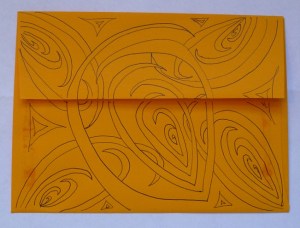
Zentangles go everywhere!
When I ran low on my gray envelope supplies, I decided to change colors and spent another couple of hours oohing and aahing over all the beautiful rainbow options. I ended up with Goldenrod paper and envelopes. Now when my letters arrived at their destination, the color would announce their arrival. Everyone would know they were getting a letter and not just junk mail. I also began to consider the backs of envelopes as art canvases and started decorating them. (Zentangles for everyone!) When I was about to run out of the Goldenrod envelopes, I tried to return to the paper warehouses where I had spent many a happy afternoon.
Gasp! They were gone! A combined effect of the economy tanking and growth of Internet shopping caused the large paper warehouses, the ones open to the public — to me — to disappear.

Zentangle Envelopes
I spent hours and hours searching online for my former envelope suppliers. I tracked down the headquarters for the last company where I bought my envelopes and called them to see if their warehouse in Houston was open to the public. Unfortunately, no. Rats!
I checked the local office supply stores for A6 envelopes. Yes, what colors? White. And more white. Occasionally an off-white. No baby blue, no sunflower, no pale green? No, no and no. Square flaps? No, again.
Looking online, I found several web sites selling A6 envelopes in lots of colors. But I couldn’t see them in person. I know that colors on one monitor may look different than an item’s actual color. Some had square flaps, some did not. Some were matte finish, some metallic, some cotton, some linen. But I couldn’t touch them. How was I supposed to decide?
Finally I caught onto the trail of stationery shops. I actually found one that stocked A6 envelopes with square flaps in different colors: The Paper Place. I showed up the following day. Even though it wasn’t a warehouse and didn’t have aisles and aisles of paper and envelopes, it had a decent selection for me to look at and touch.
Almost immediately I was drawn to the Colonial White Linen paper and envelopes. Now white is not usually my choice for envelopes, as it doesn’t particularly stand out in a pile of mail. However, I considered how well that off-white would show my art. Colonial White Linen it was, then, for my current paper and envelope choice. These were not sold by the box, so I left the shop with 25 envelopes and one pound of paper.
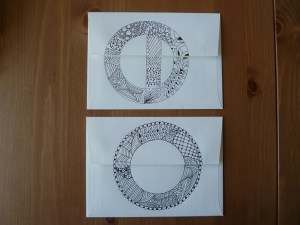
Can you tell I bought a protractor?
Do you know how long 25 envelopes lasts? Not very long, with me. Soon I was back at the shop, purchasing another 25. Hardly any time went by when I returned for a third time, as my envelope count was diminishing yet again.
Gasp! The envelope bin was empty. Oh, no! My precious A6 Colonial White Linen envelopes with a square flap! What could have happened?!
Wedding invitation month, that’s what happened. It was May and the saleswoman, after searching high and low as well as in the drawers and in the back, explained to me that these envelopes were very popular for wedding invitations.
Curses, foiled again!

Always unique
I left my name and phone number with a request for them to contact me when a new shipment arrived. As a stopgap measure, I bought 25 envelopes from another bin, in a slightly different shade of white, with speckles. I used them, but it just wasn’t the same. I was so happy when they called a couple weeks later with the news that they were holding my 25 envelopes for me. Thank you, thank you, thank you!
I can rest easy now, knowing that I have a well-stocked supply of my precious envelopes. Tomorrow morning, I’ll set down to another envelope art session. And when I write my next letter, I’ll be able to choose its mailing counterpart. “The envelope, please.”
The art of writing is the art of discovering what you believe. ~ Gustave Flaubert
What do you believe in enough that you write about it?
One advantage of using WordPress is the end-of-the-year review that they provide for their bloggers. Here’s my 2012 report. Thanks for your support!
The WordPress.com stats helper monkeys prepared a 2012 annual report for this blog.

Here’s an excerpt:
600 people reached the top of Mt. Everest in 2012. This blog got about 5,000 views in 2012. If every person who reached the top of Mt. Everest viewed this blog, it would have taken 8 years to get that many views.
Things change, to state the obvious. Some changes are not obvious, however. They happen outside of our visual range, we’re not kept in the loop, or there is no “loop” mechanism. When we discover a change, it’s sometimes startling.
In 2008, one such change caught up with me. It was during a discussion about punctuation and a co-worker mentioned that the standard was to use one space after the end of sentence, not the two spaces that I learned way back when. (I still remember that IBM Selectric in my typing class.)
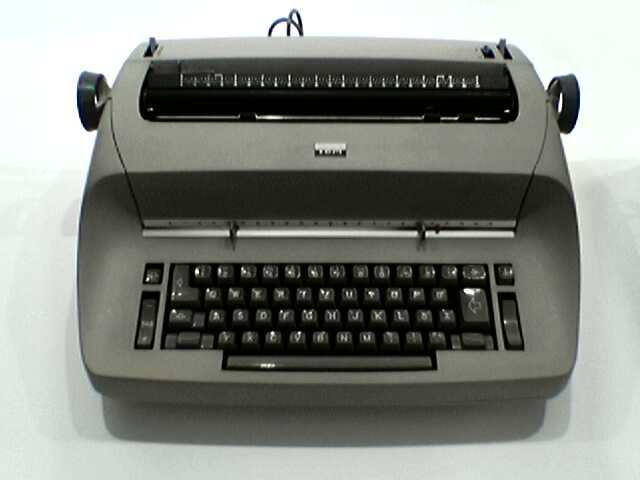
IBM Selectric
Really? One space and not two? The change was one surprise, the idea that the change had been in effect for several years without me knowing was another surprise. How does one find out these things?
One way is to keep up with writing guides, which I hadn’t been doing. It never occurred to me that punctuation might change. Now I know.
And now I have a copy of the Associated Press Stylebook; one copy at the office, one at home.

Associated Press 2012 Stylebook
With this in hand, I was aware — in a timely manner — of another change: Hopefully.
In 2008, the year of my first AP Stylebook, this is the entry for hopefully: “It means in a hopeful manner. Do not use it to mean it is hoped, let us hope or we hope. Right: It is hoped that we will complete our work in June. Right: We hope that we will complete or work in June. Wrong as a way to express the thought in the previous two sentences: Hopefully, we will complete our work in June.”
In 2012, the Associated Press changed their entry and accepts hopefully in its current, popular usage. Their new entry: “The traditional meaning is in a hopeful manner. Also acceptable is the modern usage: it’s hoped, we hope. Correct: “You’re leaving soon?” she asked hopefully. Correct: “Hopefully, we will be home before dark.”
I knew that the hopefully usage was hotly debated among grammarians. Some accepted the modern usage, others railed against it. Any time I used hopefully verbally, I felt guilty. I was careful in my writing not to use it in the “I hope” manner.
Its usage is still debated, but the tide has turned towards accepting its modern usage. There’s no going back. Now you and I can breathe easy when we use it.
So here’s my wish for the new year, 2013. Hopefully, the changes we will see will be for the better. A lot of good things happen every year, a lot of bad things happen every year. I am hopeful that the good will outweigh the bad.

