
Admittedly, these dialogues seem mostly one-sided, but I imagine they provoke plenty of verbiage not recorded.
~~~~~~~~~~~~~~~~~~~~~~~~~~~~~~~~~~~~~~~~~~~~~~~~~~~~~~~~~~~~~~~~~~~~~~~~~~~~~
Halt! Who goes there?
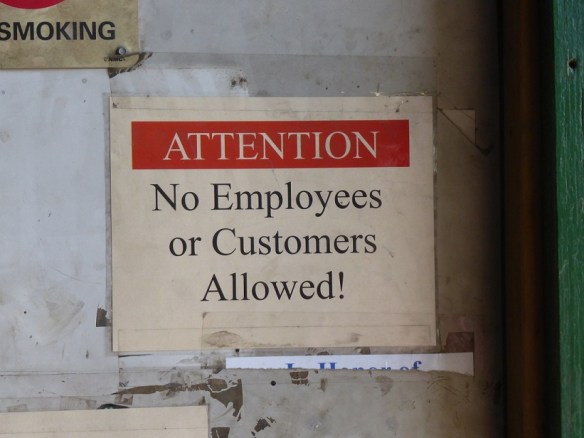
Absolutely no one allowed, ever
And the person behind the counter was . . . an impostor? A cousin of E.T.? A tourist who was lost?
~~~~~~~~~~~~~~~~~~~~~~~~~~~~~~~~~~~~~~~~~~~~~~~~~~~~~~~~~~~~~~~~~~~~~~~~~~~~~~

No kiddin’
And now for the silly part: Technically, it should read: No sittin’ or standin’ on rail.
I tried to used double and single quotes in the above sentence, but those apostrophes confused the heck out of my annotation.
I considered these possibilities:
It should read (with double quotes at the start and end and single quotes around the phrase “sittin’ or standing, with the apostrophes also inserted): “No ‘sittin’ or standin’ ‘ on rail.”
Another effort: It should read (double quotes used twice): “No “sittin’ or standin’ ” on rail.”
Splitting up the two gerunds left me with: It should read: “No ‘sittin’ ‘ or ‘standin’ ‘ on rail. Or rather: “No “sittin’” or “standin‘” on rail.” (Oh dear, now I have two colons in one sentence.)
Just so you know, I typed the gerund “g” every single time for “sittin'” and “standin'” and then had to backspace to delete it. In my speech, I drop the gerund “g” most of the time but not in my writing. When we write in a style to mimic our dialect, we add the apostrophe (sittin’), indicating that it is the story’s character who is dropping the “g.”
In any case, the sign seems to be missing the “dropped g” apostrophes. Whew! A whole dialogue between me, myself, and I. (The Oxford comma: another dialogue for another time.)
Weekly Photo Challenge: Dialogue
 It's a long story ...
The first sign must have been erected by the Lions in the Zoo!….or are they counted as employees!!!